Spanish online reading and listening practice - level B1/B2
This reading and listening exercise is based on events that occurred on 23 February 1981, when Lieutenant-Colonel Tejero led 200 civil guards in a coup d'État against the recently-formed Spanish democracy. It is suitable for level B1 Spanish students, though it contains some B2 grammar points.Background
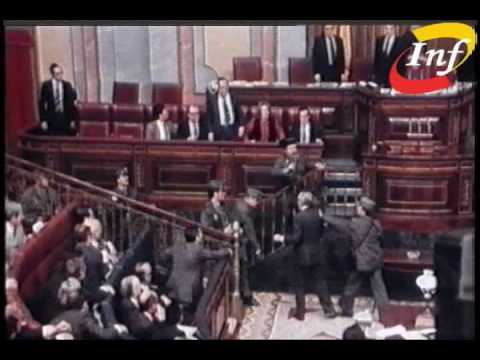
From 1939, the end of the Spanish Civil War, Spain lived under Franco's military dictatorship until his death in November 1975. Before he died he designated Prince Juan Carlos as his successor and, to the surprise of many, after becoming king, Juan Carlos I dismantled Franco's regime and began the transition to democracy, a period known in Spain as La Transición. Some say that La Transición ended with the first general election in 1977, others when the constitution was approved in 1978, and yet others argue that it definitively ended 23 February 1981, the date of the failed coup d'État led by Lieutenant-Colonel Tejero. 23 February 1981 was a dramatic and tense moment in modern Spanish history and is popularly known in Spain as 23-F. On the same day as the coup, a vote was in progress to confirm Calvo Sotelo as Prime Minister. The vote was being recorded for television, and this is the footage we see in the beginning of the video.
Shortly after the assault on Parliament another military leader, Jaime Milans del Bosch, led men and tanks into the streets of Valencia. King Juan Carlos I is widely considered to have been responsible for the failure of these actions. Wearing his military uniform of Captain-General of the Armed Forces, he went on television early in the morning of 24 February and declared his support for the democratically-elected government. With this, the insurgents, who had counted on the support of the king, knew that their action had failed. Some of the consequences of this failed coup were to give the young constitutional monarchy renewed legitimacy and in particular increased support for the King. This included not just public support, but support from political parties across the spectrum including the Communist party.
Vocabulary
There are several vocabulary lists associated with this reader:- Spanish numbers from 1 to 50
- Spanish numbers from 100 to 1000
- Subordinate conjunctions
- Prepositions
- Common Spanish time phrases
Exercise: 23-F
Watch the video, then read the transcript. Click any phrase for the translation and links to related grammar lessons which you can add to your KwizIQ notebook to practise later.
What did you think of this exercise? Leave a comment below - we love getting your feedback!
How this exercise works
- Choose your setup
Use the tick box above the text to turn translations and grammar tips on or off. When they're on, click on any phrase to see them. - Read the text
Work through the Interactive Reader at your own pace - Answer the questions
When you're ready, start the comprehension exercise
Answer in English: we're testing your understanding of the text, not your grammar or expression, so nothing you write here will be marked for accuracy. To get feedback on how you write, try one of our writing exercises.
Loading…

Coming soon
Comprehension questions for this reader haven’t been generated yet.
Couldn’t load the questions
Please try again in a moment.
Analysing your answers
Please hold! This takes a few seconds
Couldn’t check your answers
Your answers are still here — try again in a moment.
You’ve been signed out
Sign in (it opens in a new tab), then try again — your answers are still on this page.
This exercise is for Premium members
Upgrade to answer questions about this article and get personalised feedback.
Audio label
Your results
Something went wrong checking this answer.
Sign in